
The spread is the smallest number on the screen and the one that tells you the most. It is simultaneously a fee you pay, a risk somebody else is taking, and a live reading of how confident the market is. Most people only notice the first.
Two prices, always
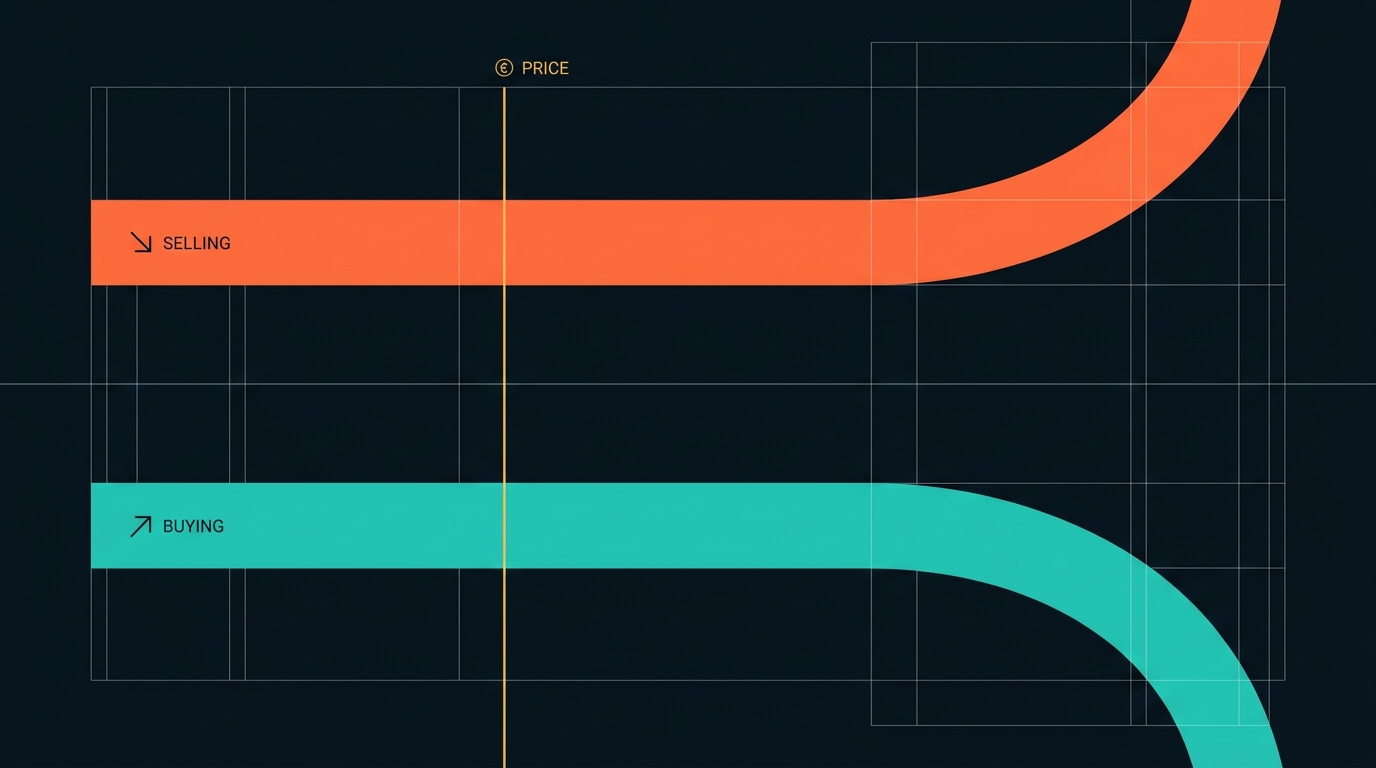
There is no such thing as "the price." There are two: the bid, the most anyone is currently willing to pay, and the ask (or offer), the least anyone is willing to accept. The gap between them is the spread.
When a chart shows you one number it is usually the last traded price, or the midpoint. Neither is available to you. If you want to buy right now you pay the ask. If you want to sell right now you receive the bid. The midpoint is a convenient fiction.
The immediate cost
Buy and instantly sell, and you lose the spread. That is the round-trip cost of impatience, and it applies before fees and before slippage.
On a liquid pair it might be a hundredth of a percent — invisible unless you trade often. On a thin one it can be a percent or more, at which point you are starting every position meaningfully behind.
This is why trading frequency matters more than most people account for. A cost you barely notice once is a cost you pay on every single round trip.
Why the gap exists at all
Somebody has to stand there quoting both sides, and that is a genuinely risky job. A market maker holds inventory that can move against them, and faces a specific hazard: the people most eager to trade with them are often the people who know something.
If you are quoting both sides and a well-informed trader lifts your offer just before the price runs, you sold too cheap. That risk is called adverse selection, and the spread is the fee charged for bearing it.
So the spread is compensation. Compress it too far and nobody quotes; the market stops having prices at all.
Reading it as a signal
Because the spread is priced risk, it moves when risk moves — and it moves first.
A widening spread means makers are nervous. They pull back before a big move more often than they lean into it. A spread that quietly doubles is a market where the professionals want more compensation to stand in front of what is coming.
A tightening spread means confidence. Competition to quote is a sign that nobody expects to be run over.
Around news, it gaps. Spreads widen dramatically in the seconds before and after a scheduled event, which is precisely when retail market orders arrive. Two facts that combine badly.
Spread and depth are different questions
A tight spread does not mean a liquid market. You can have one cent between bid and ask with almost nothing behind either — the first small order clears the top and the next one pays far worse.
Spread answers "what does it cost to trade a little?" Depth answers "what does it cost to trade a lot?" They are frequently mistaken for each other, usually by someone about to trade a lot.
What to do with it
- Check it before you cross. If the spread is unusually wide for that pair, you are paying for someone else's uncertainty.
- Consider resting inside it. A limit order between bid and ask earns the spread instead of paying it — if it fills.
- Treat sudden widening as information. Something changed, and the people whose job is to price risk noticed before you did.
On the Battle Crypto board the front line sits where buyers and sellers meet, and the spread is the ground neither army holds. When it widens you can watch the line lose definition before the move arrives — the live XRP board is free if you want to watch for it.