
The order book is the first thing most people learn to read and the last thing they should trust. It is a list of intentions, and intentions are free. The tape is a list of things that actually happened, and those cost money.
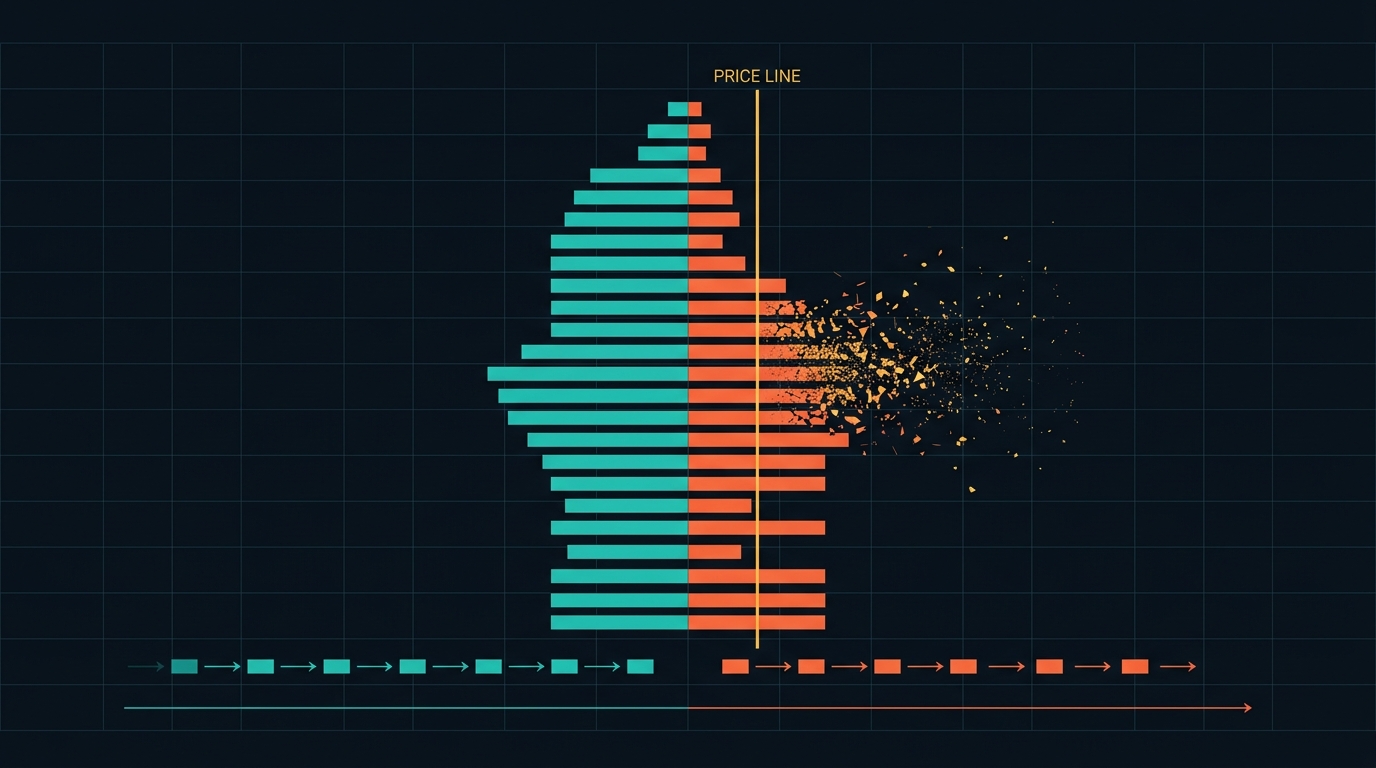
Resting orders are promises, not commitments
A limit order sitting on the book says "I am willing to trade here." It does not say "I will trade here." The person who placed it can cancel it in the time it takes you to read this sentence, and on most venues they can do it thousands of times a second, for free.
That asymmetry is the whole problem. Placing an order costs nothing. Cancelling costs nothing. Only executing costs anything. So the book is dense with information that carries no price, and the tape is sparse with information that carries all of it.
The wall that isn't there
You have seen this: a huge sell order stacked a little above the current price. Forums call it a wall. The reasoning goes that price cannot get through it, so it must come down.
Watch what happens when price actually approaches. Very often the wall thins, then evaporates, and price sails through the level where it stood. It was never load-bearing. It was there to be seen — and it worked, because you saw it.
Placing large orders you intend to cancel, to create a false impression of supply or demand, is called spoofing. In regulated futures markets it is illegal under the Dodd-Frank Act and enforced seriously — the CFTC fined JPMorgan a record $920 million for spoofing and manipulation in 2020, and people have gone to prison for it. In much of crypto it is simply Tuesday.
Layering, and why depth charts flatter
A related trick is layering: instead of one obvious wall, a series of smaller orders spread across nearby prices. It looks like broad, healthy interest. A depth chart renders it as a reassuring slope. All of it can disappear in one message.
This is why a depth chart is a picture of what people are currently willing to say. It is a sentiment survey with no obligation to respond honestly, drawn as though it were engineering tolerance.
What the tape gives you instead
An executed trade cannot be cancelled. Somebody paid. That single property makes the tape a fundamentally different kind of evidence:
- It is settled. The size is real, the price is real, the money moved.
- It has a direction. One side crossed the spread to make it happen, and that side was in a hurry.
- It cannot be faked cheaply. Spoofing the tape means actually trading, and actually trading means actually losing money when you are wrong.
Wash trading exists, and some venues have reported volume that does not survive scrutiny. But faking the tape has a cost floor that faking the book does not. That floor is the reason to prefer it.
Where the book is genuinely useful
None of this makes the book worthless. It is excellent for two things.
Estimating cost. Before you send an order, the book tells you roughly what you will pay to consume the liquidity in front of you. It may be wrong by the time you arrive, but it is the only estimate available.
Spotting the absence of liquidity. A thin book is honest in a way a thick one isn't. Nobody spoofs by removing orders. If the book is empty, it is empty.
The failure is treating resting size as a forecast. It is an offer, and offers get withdrawn.
How to hold both at once
The habit worth building is simple: let the book tell you what a trade will cost, and let the tape tell you what is happening. When the two disagree — a heavy book and a tape running the other way — believe the tape. It is the one that had to pay to speak.
This is why Battle Crypto draws executed trades as soldiers rather than drawing the book as terrain. Every figure on the field is a fill that settled. Nothing on that battlefield is an intention, and nothing on it can be withdrawn once it has marched.
If you want to see the distinction rather than read about it, the live XRP board is free and needs no account — and how to read order flow covers what to look for once you are watching.